


Polyglutamic Acid Explained: The Next-Gen Hydrator for Plump, Dewy-Looking Skin
Quick Answer: What Is Polyglutamic Acid?
Polyglutamic acid (PGA) is a long-chain polymer of glutamic acid, usually produced by fermentation, used in skincare as a surface hydrator that also forms a light film. It is not an exfoliating acid. Its appeal is that it holds water well and helps keep it from evaporating, which makes skin look plumper and more dewy — especially in cold, dry conditions. It layers naturally with hyaluronic acid rather than replacing it. PROGEN's Bio-Innovation R&D center formulates PGA systems through OEM/ODM customization.
1. What Is Polyglutamic Acid?
Despite the word "acid," polyglutamic acid is not an exfoliant. It is a polymer made of repeating glutamic acid units — a long, water-loving chain that sits on the surface of the skin and holds water there.
The name confuses people because acids like glycolic and salicylic behave completely differently. PGA does not dissolve dead skin cells and does not sting. It hydrates, and it leaves a light film that slows water loss.
2. Fermentation and the Two Forms
Most cosmetic PGA is produced through bacterial fermentation, traditionally associated with natto — fermented soybeans. The fermentation route matters for two reasons: it is renewable and biodegradable, and it gives brands a sourcing story that holds up to scrutiny.
| Form | Character | Where it appears |
|---|---|---|
| Gamma-PGA | Fermentation-derived; the standard for skincare | Serums, essences, creams, masks |
| Alpha-PGA | Less common in cosmetics | Specialty or research contexts |
If you are reading a specification sheet, gamma-PGA is the form to look for in a skincare brief.
3. How It Works — Film-Forming Hydration
PGA does two things at once. It binds water, like other humectants, and it forms a thin, breathable film that helps keep that water from evaporating.
That second part is what separates it from a simple humectant. A humectant pulls water in; a film keeps it there. PGA is unusually good at the second job, which is why it is often described as a "sealing" hydrator.
The Core Insight: Hyaluronic acid draws water in. PGA helps keep it there. The strongest routines use both — one for depth, one for the surface seal.
4. PGA vs Hyaluronic Acid
| Factor | Polyglutamic Acid | Hyaluronic Acid |
|---|---|---|
| Water retention | Higher; holds several times more | The category benchmark |
| Where it acts | Mostly surface, with a film | Surface and upper layers |
| Finish | Slightly tacky at higher levels; dewy | Slippery, fast-absorbing |
| Best for | Cold, dry air; dehydration; barrier comfort | Immediate plumping and slip |
| Layering | Goes after HA to seal | Goes first, on damp skin |
They are complementary, not competitive. HA hydrates; PGA helps hold the result. Using them in that order is the practical takeaway.
5. Why It Suits Winter
Heated rooms, cold outdoor air, and constant switching between the two are a recipe for dehydrated skin. PGA's film is particularly useful in that environment because it slows water loss without feeling occlusive.
- Low humidity — the film reduces evaporation when the air is dry.
- Heated interiors — helps skin stay comfortable through long indoor days.
- Travel — cabin air is a classic dehydration scenario.
- Light texture — it does not feel like a heavy balm, so it works under makeup.
6. How to Use PGA in a Routine
- Apply to damp skin. PGA performs best when there is water available to hold.
- Order: hyaluronic acid first, then PGA, then moisturizer.
- Morning: cleanse → HA → PGA → moisturizer → SPF.
- Evening: cleanse → PGA essence or serum → moisturizer.
- Good companions: hyaluronic acid, niacinamide, beta-glucan, ceramides, squalane.
7. Formulating with PGA — What Brands Ask
- Use level. 2–3% is the practical sweet spot; above that, tackiness rises faster than performance.
- Molecular weight. Higher molecular weight gives more film; lower gives more slip. The grade changes the feel.
- Texture. PGA adds body and a slight cling; it is easier to place in essences and gels than in rich creams.
- Stability. It is generally robust, but electrolytes and preservation still need standard stability work.
- Claims language. "Hydrating," "helps seal in moisture," and "plumper-looking" are accurate; avoid claims about the skin's internal processes.
8. Common Misconceptions
- "It's an exfoliating acid." No. It does not resurface or sting.
- "More is better." Beyond roughly 3%, texture suffers before benefits improve.
- "It replaces hyaluronic acid." Different jobs — one hydrates, one seals.
- "It works instantly and forever." The finish is immediate; the comfort depends on continued use and a moisturizer on top.
9. PROGEN's Take — OEM/ODM PGA Customization
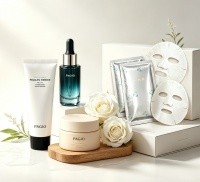
PGA fits the hydration layer of a routine, and it pairs naturally with the soothing formats we already produce — including the Vitamin B5 Soothing Mask, where panthenol and calming botanicals do the comforting and a humectant system does the water-holding. Typical OEM/ODM options:
- Formats — essences, serums, gel-creams, creams, and sheet-mask essences.
- Custom use levels from 1% upward, balanced against tackiness.
- Co-actives — hyaluronic acid, niacinamide, beta-glucan, panthenol, ceramides, squalane.
- Positioning — winter hydration, dehydration-focused, or fragrance-free sensitive-skin lines.
See the full facial care series for where a PGA layer would sit, then scope your own version through our OEM/ODM service. The Bio-Innovation R&D team handles texture and stability work before launch.
Is polyglutamic acid better than hyaluronic acid?
Not better — different. PGA holds more water and forms a film at the surface; HA penetrates further and gives immediate slip. Most strong formulas use both, with HA first and PGA after.
Is polyglutamic acid an exfoliant?
No. Despite the name, it does not dissolve dead skin cells and does not sting. It is a humectant polymer, not an AHA or BHA.
Can I use it every day?
Yes. It is generally well tolerated and can be used morning and night. If a formula feels tacky, apply less or choose a lower percentage.
Does it work in humid weather?
It works anywhere, but its advantage is clearest in dry conditions. In humid climates, a lighter layer is usually enough.
Build Your Hydration Line with PROGEN
From PGA essences to cushiony winter creams, PROGEN develops and manufactures next-generation hydration formulas under your brand.
Explore OEM/ODM HydrationGMP-certified manufacturing · Essence / Serum / Cream / Mask · 1%+ custom levels